A few weeks ago we had family powerpoint night. Yep, powerpoint night. Five slides, five minutes each with the theme of Climate Change and our home. Each member of the family presented on a topic – transport, fashion, food, power, water and waste. We listened, we laughed a lot. We ate snacks. At the end of it we came up with some strategies to reduce our impact that our family has on the environment. Some we can implement straight away, and some will take some time and some saving. Our philosophy is that small changes add up.
As a GP I am already seeing the impact of climate change on the health of our patients, and on the delivery of our medical services. In early 2020 I was working the Saturday shift at our practice. There was a bushfire raging to the south, and as I drove to work I stopped at the RACF I attend to check on my patients. A plume of smoke filled the sky above the building.
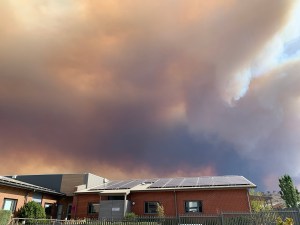
Within the RACF air humidifiers were being used to try and improve the air quality. Some of our patients have heart failure, some have lung disease, some have dementia. We talked to the team and families about how to manage their individual care with all the smoke in the air, and then what to do if the fire got closer or the power was lost. Some elected to take their loved ones home for a few days, for others it was not an option.
When I walked into our clinic the smoke was thick in the air inside and out. A haze of smoke had settled in front of the reception desk. We had power, but were aware that we had to be ready just in case. The emergency packs were pulled out – ready to convert to pen and paper if needed. Our phone lines were quieter that day. A few patients attended because they were worried about their breathing, others to make sure they had scripts for their inhalers. Some attended with worsening anxiety having been through the bushfires in 2003 and worried about their homes and their family. In addition to the fire threat it was hot. We talked about ways to stay cool and explored places that people could stay if their houses were too hot.
When we consider climate change we talk how it might effect our breathing if it is smokey, or how we will manage to stay cool when the evening temperatures fail to drop after a days of extreme heat. What we don’t always consider is the impact of climate change on our health services – power outages can make it difficult to organise appointment or delay treatments, extreme heat waves increase attendances to emergency departments, surgeries cancelled because the air quality in theatre is too poor.
We all have a role to play in addressing climate change. Some of it happens in our own home – our consumption of food and plastics, our use of solar panels and looking to convert to electric vehicles. We also need a big commitment from Government to take climate change seriously. We don’t have time to wait. Before the next election I would encourage you to speak to your local candidates about what their plan is to protect you and our community. Ask them whether they have considered the impact of climate change on health.
 Dr Kerrie Aust